


Why the Conveyor Belt Market Is Expected to Grow at a 5.3% CAGR During 2025 to 2031
A conveyor belt is a widely used mechanical system designed to transport materials, goods, or products efficiently and continuously within industrial and commercial environments. It consists of a durable belt mounted on rollers or pulleys and driven by an electric motor to move items along a fixed path. Conveyor belts are commonly found in manufacturing plants, warehouses, distribution centers, mining operations, airports, and food processing facilities. By automating material movement, conveyor belts help improve workflow efficiency, reduce manual handling, enhance safety, and support faster, more reliable production and logistics operations.
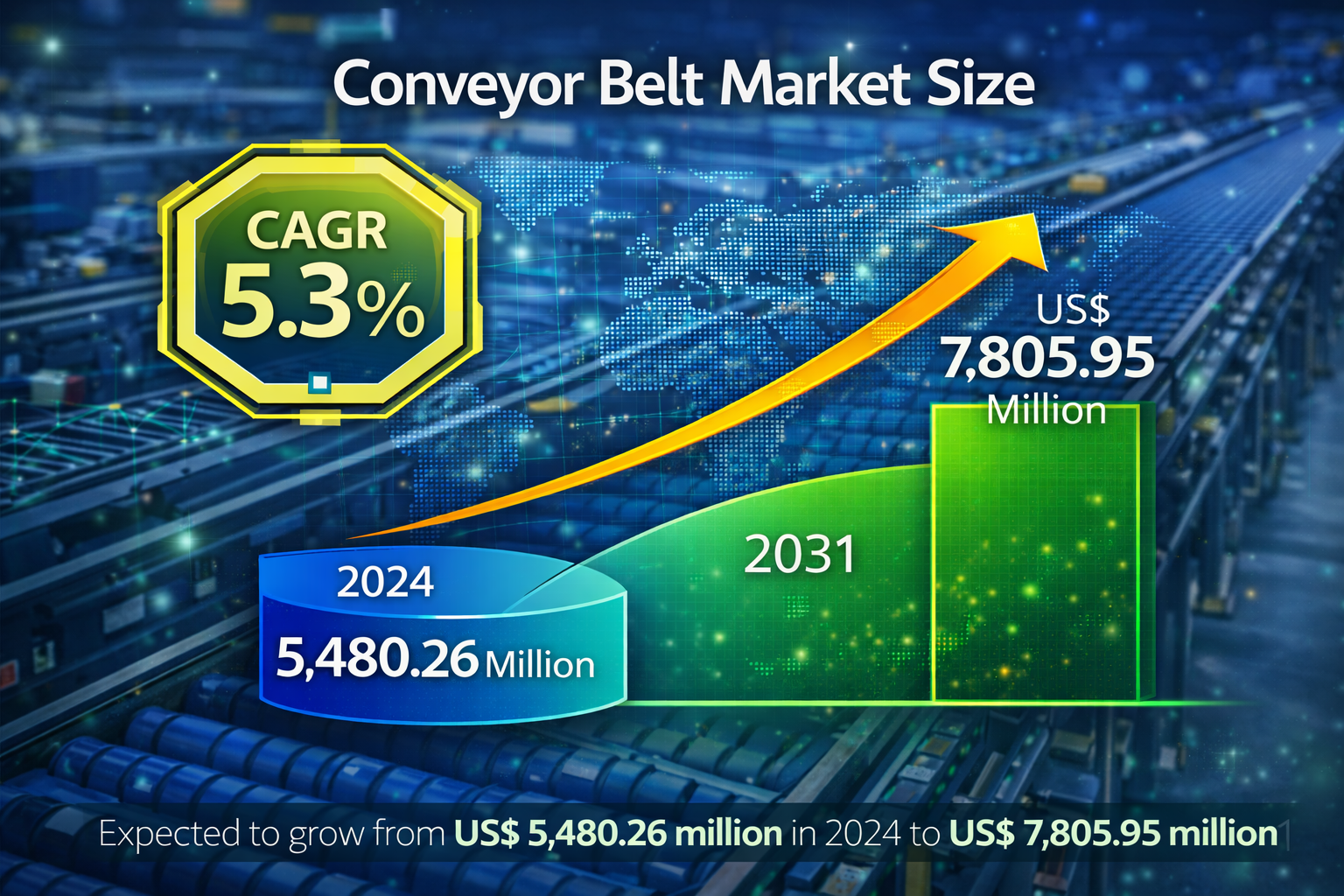
The conveyor belt market is positioned for steady expansion during the forecast period, with a projected CAGR of 5.3 percent from 2025 to 2031. According to Conveyor Belt Market Dynamics, Recent Developments, and Strategic Insights by 2031, the market is expected to grow from US$ 5,480.26 million in 2024 to US$ 7,805.95 million by 2031. This sustained growth reflects the rising importance of automated material handling across industrial, logistics, and infrastructure sectors.
Rising Demand for Industrial and Warehouse Automation
One of the primary factors driving market growth is the accelerating adoption of automation across manufacturing and warehousing environments. Industries such as automotive, general manufacturing, food and beverage, recycling, and aerospace and defense increasingly rely on conveyor belt systems to enhance productivity and reduce dependence on manual labor. Conveyor belts improve workflow continuity, reduce error rates, and support higher throughput, making them essential for modern production facilities.
Warehouse automation, in particular, is a major growth catalyst. The rapid expansion of e commerce, last mile delivery models, and omnichannel retailing has increased the need for fast, accurate, and cost efficient order fulfillment. Conveyor belts play a central role in automated warehouses by enabling smooth movement of goods between storage, sorting, and packaging zones.
Expansion of Airport Infrastructure
Global airport expansion projects are another significant contributor to the projected CAGR. Rising air passenger traffic and cargo volumes are compelling governments and airport operators to invest in modern infrastructure. Advanced conveyor belt systems are essential for baggage handling and cargo transport, ensuring reliable operations even during peak traffic periods.
Large scale investments in airport modernization across North America and Europe are boosting demand for automated, high capacity conveyor systems. These systems enhance operational efficiency, reduce delays, and improve overall passenger experience, strengthening the long term growth outlook for the market.
Technological Advancements and Smart Conveying
The integration of digital technologies is reshaping the conveyor belt market and supporting its steady growth. Smart conveying systems equipped with sensors, real time monitoring, and data analytics enable predictive maintenance and performance optimization. This reduces downtime and extends equipment life, which is particularly valuable for industries operating continuous production cycles.
The adoption of Industry 4.0 practices in Europe and Asia Pacific is accelerating demand for conveyor belts that can integrate with IoT platforms, artificial intelligence tools, and automated control systems. These technologies transform conveyor belts from passive components into intelligent assets that actively support operational decision making.
Segment Level Growth Contributions
From a segmentation perspective, flat belt conveyors dominated the market in 2024 due to their versatility across industries. Rubber based conveyor belts also held a leading share, supported by their durability and suitability for medium weight and heavy weight applications. Medium weight conveyor belts remain the most widely used category, balancing strength, flexibility, and energy efficiency.
Among end use industries, general manufacturing leads demand as companies seek to optimize internal logistics and production efficiency. Mining and metals continue to drive adoption of heavy duty conveyor belts, while food and beverage and retail sectors support growth in lightweight and hygienic conveying solutions.
Download a sample PDF: https://www.theinsightpartners.com/sample/TIPRE00014724
Regional Market Strength
Asia Pacific leads the global conveyor belt market, supported by rapid industrialization, expanding manufacturing bases, and rising investments in warehouse automation. North America and Europe follow closely, driven by technological innovation, airport expansion, and smart manufacturing initiatives.
European manufacturers are increasingly focused on data driven production systems, which strengthens demand for advanced conveyor solutions capable of real time monitoring and adaptive control. This regional emphasis on efficiency and sustainability aligns closely with the market’s overall growth trajectory.
Key Players Supporting Market Expansion
-
Habasit AG offers high performance and application specific conveyor solutions
-
Forbo Holding AG focuses on energy efficient and hygienic belt technologies
-
Semperit AG Holding serves heavy duty and industrial applications
-
Fenner Dunlop supports large scale automated material handling
-
Dorner Mfg. Corp. delivers modular and compact conveyor systems
-
BEUMER Group specializes in automated logistics and airport conveying systems
Competitive Landscape and Market Dynamics
The competitive environment remains dynamic, with companies leveraging product innovation, extensive distribution networks, and strategic acquisitions to strengthen market presence. Sustainability has also become a key differentiator, with manufacturers investing in eco friendly materials and energy efficient belt designs to meet regulatory and customer expectations.
Future Outlook
Looking ahead, the conveyor belt market’s projected 5.3 percent CAGR reflects a balanced combination of industrial expansion, infrastructure development, and technological advancement. As automation continues to penetrate manufacturing, logistics, and transportation sectors, conveyor belt systems will remain a foundational component of efficient material handling. Continuous innovation and smart system integration are expected to further reinforce market growth through 2031.
Related Report
Active Seat Belt System Market Report by Share, Growth and Size: 2031
https://www.theinsightpartners.com/reports/active-seat-belt-system-market
Rubber Conveyor Belt Market: Size, Share, and Growth Analysis by 2031
https://www.theinsightpartners.com/reports/rubber-conveyor-belt-market
Belt Press Filter Market: Expert Analysis by Size and Share 2031
https://www.theinsightpartners.com/reports/belt-press-filter-market

 English
 Arabic
 Spanish
 Portuguese
 Deutsch
 Turkish
 Dutch
Dutch
 Italiano
 Russian
 Romaian
 Portuguese (Brazil)
 Greek
Greek